Author: Daniel Sasu

  • SEKONDI FLOOD SCARE: NADMO’s Swift Evacuation Order Averts Potential Disaster

    SEKONDI FLOOD SCARE: NADMO’s Swift Evacuation Order Averts Potential Disaster

    Rapid Response by Disaster Management Agency Praised as Heavy Rains Threaten Coastal Communities

    A potential humanitarian disaster was narrowly avoided in Sekondi-Takoradi after swift intervention by the National Disaster Management Organisation, which ordered the evacuation of residents from high-risk flood zones ahead of rising water levels.

    The emergency response, coordinated by the National Disaster Management Organisation (NADMO), is being credited with preventing significant loss of life and property as torrential rains battered parts of Ghana’s coastal belt.

    Residents Moved to Safety as Water Levels Rose

    According to officials, early warning signals and rapid field assessments prompted authorities to act decisively, relocating households in vulnerable areas before conditions deteriorated further.

    Eyewitnesses described tense scenes as families gathered essential belongings and moved to safer locations, while emergency teams monitored drainage channels and flood-prone communities.

    Authorities Praise Early Warning Systems

    Disaster management officials say the situation underscores the importance of timely alerts and community compliance with evacuation directives, especially in low-lying urban settlements prone to seasonal flooding.

    They noted that years of flooding incidents across parts of Ghana have reinforced the need for stronger preparedness, improved drainage infrastructure, and stricter enforcement of building regulations in high-risk zones.

    Preventing a Repeat of Past Disasters

    Officials emphasized that the prompt evacuation helped avoid a repeat of previous flood disasters that have claimed lives and destroyed property in similar conditions.

    They are now urging residents in flood-prone areas to remain vigilant as weather patterns remain unpredictable, warning that additional rainfall could still pose risks in the coming days.

    Call for Long-Term Resilience Measures

    While praising the successful evacuation, experts say the incident highlights the need for long-term investment in flood control systems, urban planning, and community education on disaster preparedness.

    For now, authorities maintain that the swift action by NADMO stands as a clear example of how early intervention can turn a potential catastrophe into a managed emergency.

  • “BIG BOOST FOR GIRLS!” — Development Bank Ghana Distributes 10,000 Sanitary Pads Across 4 Regions

    “BIG BOOST FOR GIRLS!” — Development Bank Ghana Distributes 10,000 Sanitary Pads Across 4 Regions

    Accra, Ghana – In a major push to support girl-child education and menstrual hygiene, the Development Bank Ghana has distributed 10,000 sanitary pads to schoolgirls across four regions, sparking praise for what many describe as a timely intervention to reduce absenteeism and promote dignity in schools.

    The initiative, which targets adolescent girls in underserved communities, is aimed at tackling one of the silent but persistent barriers to education—lack of access to affordable menstrual hygiene products.

    Officials from the bank say the distribution forms part of its broader social impact agenda, which focuses on empowering vulnerable groups and strengthening human capital development nationwide.

    Beneficiary schools reportedly welcomed the intervention with enthusiasm, with teachers noting that menstrual-related absenteeism remains a key challenge affecting academic performance and confidence among female students.

    Education stakeholders and child welfare advocates have long argued that access to sanitary products is not a luxury but a necessity for ensuring equal participation in education, especially in rural and low-income communities.

    The programme has therefore been hailed as a practical step toward improving school retention rates for girls while also promoting health, dignity, and gender equality.

    As calls grow for more sustained interventions, observers say initiatives like this could help close long-standing gaps in educational equity if expanded and consistently supported.

    For many of the beneficiaries, however, the impact is immediate and personal—offering relief, confidence, and the chance to stay in school without interruption.

  • Specialist Pharmacy Training Crucial for Stronger Primary Healthcare System – Health Ministry Declares

    Specialist Pharmacy Training Crucial for Stronger Primary Healthcare System – Health Ministry Declares

    Accra, Ghana – The Ministry of Health (Ghana) has emphasized that specialist pharmacy training is a critical pillar in strengthening the country’s primary healthcare system, calling for increased investment in advanced skills development for pharmacy professionals.

    According to the Ministry, improving specialised training for pharmacists will significantly enhance service delivery at the primary care level, ensuring safer medication use, improved patient outcomes, and more efficient management of essential drugs across health facilities.

    Officials noted that as healthcare delivery becomes increasingly complex, pharmacists must be equipped with advanced clinical and technical competencies to effectively support doctors, nurses, and other health workers in delivering quality care.

    The Ministry stressed that specialist pharmacy practice plays a key role in areas such as rational drug use, chronic disease management, antimicrobial stewardship, and patient counselling—particularly within community and district health settings.

    Stakeholders within the health sector have also echoed the call, arguing that strengthening pharmacy training programmes will help reduce medication errors, improve treatment adherence, and ease pressure on overburdened primary healthcare systems.

    The Ministry further indicated that ongoing reforms are aimed at aligning pharmacy education and training with global best practices to ensure that Ghana’s health workforce remains responsive to emerging public health needs.

    The call forms part of broader efforts to build a resilient and efficient primary healthcare system capable of delivering accessible, high-quality care to all citizens.

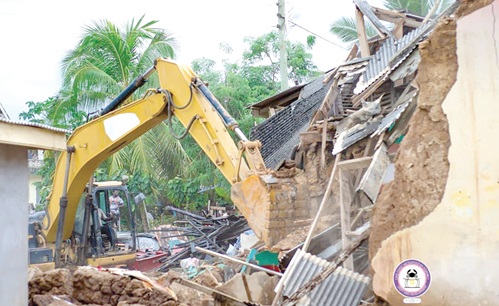
  • FLOOD CRISIS SHOCKER: 155 UNSAFE STRUCTURES MARKED FOR DEMOLITION AFTER CENTRAL REGION DISASTER

    FLOOD CRISIS SHOCKER: 155 UNSAFE STRUCTURES MARKED FOR DEMOLITION AFTER CENTRAL REGION DISASTER

    Authorities Move in as Devastation Exposes Dangerous Buildings and Poor Urban Planning

    A wave of urgent demolition actions is expected in parts of the Central Region after devastating floods left authorities with no choice but to mark as many as 155 structures as unsafe and unfit for habitation.

    The decision follows intense flooding that swept through several communities, exposing weak infrastructure, poorly sited buildings, and long-standing drainage challenges that have now turned into a full-blown safety crisis.

    Officials say the affected structures have been declared structurally compromised and pose a serious risk to human life if left standing. Many of the buildings, according to preliminary assessments, were either built on waterways, lacked proper foundations, or failed to meet basic construction standards.

    Residents in the affected areas have been left in shock as demolition notices are being served, with many facing the grim reality of losing homes and businesses in the aftermath of the floods.

    Emergency response teams, alongside urban planning and disaster management authorities, are reportedly working to ensure that evacuations are carried out safely before demolition exercises begin.

    The flooding, which has once again highlighted the vulnerability of communities in the region, has sparked renewed debate over urban planning enforcement, environmental management, and the rising impact of extreme weather events.

    Authorities Sound Alarm on Human Settlement Risks

    Officials warn that the situation could have been far worse, stressing that the identification of unsafe structures is a preventive measure to avoid future tragedies such as building collapses or loss of life during heavy rains.

    They are also urging residents to comply with evacuation directives while government agencies develop longer-term plans to resettle displaced families and improve drainage systems.

    Floods Expose Deep Infrastructure Gaps

    The disaster has reignited concerns over poor drainage networks, rapid urbanisation, and weak enforcement of building regulations—issues that continue to worsen flooding impacts across the region.

    As demolition looms, affected communities are bracing for disruption, uncertainty, and the difficult task of rebuilding their lives from the ground up.

    For many residents, the floods have become more than just a natural disaster—they are a stark reminder of the urgent need for stronger planning systems and climate-resilient infrastructure.

    The coming days are expected to be critical as authorities move to enforce safety measures while balancing humanitarian concerns for displaced families.

  • “NO MORE EXCUSES!” — Government Sets Up Special Unit to Track Policy Execution as Pressure Mounts for Results

    “NO MORE EXCUSES!” — Government Sets Up Special Unit to Track Policy Execution as Pressure Mounts for Results

    New Oversight Mechanism Introduced to Tackle Implementation Gaps

    The government has established a new dedicated unit tasked with monitoring and tracking the execution of public policies, in a move aimed at improving accountability, speeding up delivery, and ensuring that national development plans are fully implemented.

    The initiative comes amid persistent concerns that well-designed policies often fail to achieve their intended impact due to weak implementation, delays, and coordination challenges across government institutions.

    Focus on Results, Not Just Promises

    According to officials, the newly created unit will be responsible for following through on government commitments, assessing progress on key projects, and identifying bottlenecks that slow down delivery.

    The move signals a shift toward a more results-oriented governance approach, where ministries, departments, and agencies are expected to demonstrate measurable outcomes rather than simply announce policy intentions.

    A senior government source described the initiative as a “game-changer” in public administration, designed to ensure that policies translate into real benefits for citizens.

    Closing the Gap Between Policy and Delivery

    For years, concerns have been raised about the gap between policy formulation and actual implementation, with critics arguing that delays and inefficiencies have weakened public trust in governance.

    The new tracking unit is expected to serve as a central coordination point, bringing together data on projects and policies across sectors such as health, education, infrastructure, and economic development.

    Pressure to Deliver on National Expectations

    The establishment of the unit comes at a time when citizens are increasingly demanding visible results from government programmes, particularly in areas such as job creation, public service delivery, and infrastructure development.

    Analysts say the success of the initiative will depend on its independence, authority, and ability to hold implementing agencies accountable without political interference.

    Will It Make a Difference? — Experts Weigh In

    Policy observers have welcomed the idea as a step in the right direction but caution that similar initiatives in the past have struggled due to weak enforcement powers and bureaucratic overlap.

    They argue that for the unit to succeed, it must be properly resourced, empowered to demand compliance, and supported at the highest levels of government.

    A Test of Governance Efficiency

    As expectations rise, the new policy tracking unit is being seen as a litmus test for the government’s commitment to improving efficiency and delivering tangible development outcomes.

    Whether it becomes a powerful engine for accountability or another layer of bureaucracy will depend on how strongly it is implemented in practice.

    For now, citizens and stakeholders alike will be watching closely to see if this new initiative finally closes the long-standing gap between policy design and real-world impact.

  • WHEN THE SYSTEM FAILS: Rethinking Discipline in Senior High Schools Amid Rising Concerns Over Order and Authority

    WHEN THE SYSTEM FAILS: Rethinking Discipline in Senior High Schools Amid Rising Concerns Over Order and Authority

    Educators Warn That Weak Enforcement and Changing Social Norms Are Reshaping Student Behaviour in Senior High Schools

    A growing debate is emerging within education circles over discipline and authority in senior high schools, as stakeholders question whether existing systems are strong enough to maintain order and prepare students for life beyond the classroom.

    Across many institutions in Ghana, concerns are being raised about declining adherence to school rules, increasing incidents of indiscipline, and what some educators describe as a gradual erosion of respect for authority within the school environment.

    A System Under Pressure

    Teachers and administrators say the challenge is no longer limited to isolated cases of misconduct but reflects broader structural and societal changes affecting student behaviour.

    They point to shifting attitudes, stronger peer influence, and the growing impact of social media as factors that are reshaping how students respond to rules and correction in senior high schools.

    While the education system continues to emphasize academic performance, critics argue that discipline frameworks have not evolved at the same pace as student realities, leaving schools struggling to enforce consistent standards.

    The Role of Enforcement and Authority

    Education stakeholders are increasingly questioning whether disciplinary measures are being applied effectively and fairly across schools.

    Some argue that weakened enforcement mechanisms, coupled with uncertainty over punishment protocols, have made it harder for school authorities to maintain firm control.

    Others, however, caution against overly harsh disciplinary approaches, insisting that modern education must balance discipline with psychological support, guidance, and student rights.

    A Call for Reform and Rebalancing

    Education experts are calling for a comprehensive rethink of discipline policies in senior high schools, including clearer guidelines, stronger teacher support systems, and improved collaboration between schools, parents, and education authorities.

    They stress that discipline should not be viewed purely as punishment but as part of a broader effort to build character, responsibility, and citizenship among young people.

    Beyond Punishment: A Cultural Shift Needed

    Many observers believe the issue goes beyond school rules and reflects wider societal changes in attitudes toward authority and accountability.

    They argue that restoring discipline in schools will require not only policy reforms but also a cultural shift involving families, communities, and national institutions.

    The Stakes for the Future

    As the debate continues, educators warn that failure to address the issue could undermine academic outcomes and weaken the development of responsible future leaders.

    For many stakeholders, the central question is no longer whether discipline is important—but whether the current system is equipped to deliver it effectively in a rapidly changing world.

  • “ENOUGH DELAY!” — Federation of Disability Organisations DEMANDS PASSAGE AND STRICT ENFORCEMENT OF DISABILITY RIGHTS BILL

    “ENOUGH DELAY!” — Federation of Disability Organisations DEMANDS PASSAGE AND STRICT ENFORCEMENT OF DISABILITY RIGHTS BILL

    Accra, Ghana – The Federation of Disability Organisations has intensified its call for urgent parliamentary action, demanding the swift passage and rigorous enforcement of the Disability Rights Bill to strengthen protections for persons living with disabilities across the country.

    In a strongly worded appeal, the federation warned that continued delays in fully implementing disability legislation are leaving thousands of citizens vulnerable to discrimination, exclusion, and limited access to essential services such as education, healthcare, and employment.

    The organisation stressed that while Ghana has made some progress in promoting disability inclusion, enforcement remains weak and inconsistent—allowing avoidable barriers to persist in both public and private spaces.

    According to the federation, passing the bill is only the first step; the real challenge lies in ensuring strict compliance, accountability, and monitoring across all sectors of society.

    It called on policymakers to prioritize accessibility standards in infrastructure, enforce equal opportunity laws in workplaces, and guarantee inclusive education systems that do not leave persons with disabilities behind.

    The federation also urged government agencies to move beyond “policy promises” and take concrete action that translates legal rights into real-life improvements for affected individuals and families.

    Disability advocates have echoed the call, warning that without stronger enforcement mechanisms, existing gaps will continue to undermine national inclusion efforts and international commitments.

    As pressure mounts, stakeholders say Parliament now faces growing expectations to fast-track reforms that could redefine how disability rights are protected and upheld in Ghana.

    For many, the message from the federation is clear and urgent: legislation without enforcement is not enough—real change must be felt on the ground.

  • Civilian–Security Dialogue Held at Wiesi to Strengthen Peace and Community Relations

    Civilian–Security Dialogue Held at Wiesi to Strengthen Peace and Community Relations

    Wiesi, Ghana – A high-level civilian–security dialogue has been held at Wiesi, bringing together community members, traditional leaders, and security officials in a renewed effort to strengthen trust, improve cooperation, and enhance local peacebuilding efforts.

    The engagement formed part of ongoing initiatives aimed at bridging the gap between civilians and security agencies, while addressing emerging concerns around safety, community policing, and conflict prevention.

    Participants at the forum discussed key issues affecting the area, including security challenges, early warning mechanisms, and the importance of timely information sharing between residents and security personnel. Officials stressed that effective collaboration is essential in preventing misunderstandings and maintaining stability within communities.

    Security representatives used the platform to reassure residents of their commitment to protecting lives and property, while also encouraging the public to support law enforcement operations through cooperation and responsible reporting of suspicious activities.

    Community leaders and residents welcomed the dialogue, describing it as timely and necessary for fostering mutual understanding. They called for more frequent engagements to ensure that security concerns are addressed promptly and that trust between both sides continues to grow.

    The event ended with a renewed pledge from stakeholders to work together in promoting peace, security, and development in Wiesi and surrounding communities.

  • PROF. KWAKU AZAR SET TO DROP BOMBHELL LECTURE: “Political Parties Are Losing Their Vision and Ideological Compass”

    PROF. KWAKU AZAR SET TO DROP BOMBHELL LECTURE: “Political Parties Are Losing Their Vision and Ideological Compass”

    Renowned Legal Scholar to Diagnose What He Calls a Growing Crisis in Party Politics

    Renowned academic and public commentator, Professor Kwaku Azar, is set to deliver a hard-hitting public lecture examining what he describes as the steady drift of political parties away from clear visions and firm ideological foundations.

    The lecture, expected to attract policymakers, academics, students, and political actors, will focus on the increasing perception that modern political parties are becoming more personality-driven, election-focused, and less anchored in coherent ideological principles.

    Prof. Azar is expected to argue that this trend is weakening democratic accountability and blurring the distinctions between major political actors, leaving voters with limited ideological clarity when making electoral choices.

    According to preliminary information, the lecture will critically assess how political branding, campaign messaging, and governance practices have, over time, shifted away from long-term philosophical commitments toward short-term political convenience.

    Observers say the event is likely to spark intense national debate, particularly among political party loyalists who may either welcome the critique as a necessary wake-up call or reject it as an overgeneralisation of Ghana’s political landscape.

    The discussion comes at a time when concerns about political consistency, policy continuity, and ideological identity have increasingly featured in public discourse.

    A Wake-Up Call for Party Politics?

    Prof. Azar is expected to challenge political actors to revisit foundational principles, strengthen internal ideological education, and restore clearer distinctions in party philosophies to enhance democratic maturity.

    His remarks are likely to resonate beyond academia, touching on broader concerns about governance, accountability, and the long-term direction of political development.

    As anticipation builds, the lecture is already being framed as a potentially defining moment in the ongoing conversation about the future of party politics and ideological discipline.

    Whether it triggers reform or controversy, one thing is clear: Prof. Azar’s intervention is set to reignite a national conversation about what political parties stand for—and whether they still stand for anything at all.

  • “FINISH WHAT YOU STARTED!” — Ahiagbah Urges Government to Fully Fund and Complete Afari Hospital Amid Growing Public Pressure

    “FINISH WHAT YOU STARTED!” — Ahiagbah Urges Government to Fully Fund and Complete Afari Hospital Amid Growing Public Pressure

    Government Under Fire as Key Health Project Faces Delays

    The New Patriotic Party’s Director of Communications, Richard Ahiagbah, has called on the government to urgently commit the necessary financial and logistical resources to complete the long-delayed Afari Hospital project, warning that continued delays could undermine public confidence in Ghana’s healthcare delivery system.

    His appeal adds to mounting public concern over stalled or slow-moving infrastructure projects, particularly in the health sector, where citizens continue to demand improved access to quality medical services.

    “The People Cannot Wait Forever” — Ahiagbah Sounds Alarm

    Ahiagbah stressed that the Afari Hospital project represents more than just a construction site—it is a critical national asset expected to ease pressure on existing health facilities and improve healthcare delivery in the Ashanti Region and beyond.

    He urged authorities to prioritize the completion of the facility, insisting that adequate funding and strong political will are essential to ensure the project does not become another abandoned promise.

    “The people cannot wait forever for essential healthcare infrastructure,” he warned, emphasizing that delays in completing the hospital directly affect patients, families, and frontline health workers.

    Rising Concerns Over Delayed Infrastructure Projects

    The call comes amid renewed scrutiny of public infrastructure development, with citizens and stakeholders increasingly questioning timelines, funding gaps, and contractor performance on major government projects.

    Health sector advocates have repeatedly highlighted the importance of completing major hospitals like Afari to reduce congestion in existing regional and teaching hospitals, where patient numbers continue to surge.

    Afari Hospital Seen as Strategic Health Investment

    Once completed, the Afari Hospital is expected to serve as a major healthcare hub, improving emergency response capacity, specialist care, and overall access to medical services in the region.

    Analysts say its completion could significantly strengthen Ghana’s health infrastructure network, but only if consistent funding and oversight are maintained to avoid further delays.

    Government Pressured to Deliver on Promises

    Ahiagbah’s remarks are likely to intensify political pressure on the government to demonstrate commitment to completing key infrastructure projects on schedule.

    While supporters of the administration argue that progress is being made despite economic constraints, critics insist that unfinished projects continue to erode public trust.

    A Test of Commitment to Public Service Delivery

    As debate over infrastructure delivery continues, the fate of the Afari Hospital has become symbolic of broader concerns about project completion, accountability, and governance efficiency.

    For many citizens, the message is clear: promises alone are not enough—delivery is what matters.

    Whether the government accelerates funding and completion efforts or allows delays to persist will be closely watched in the months ahead.