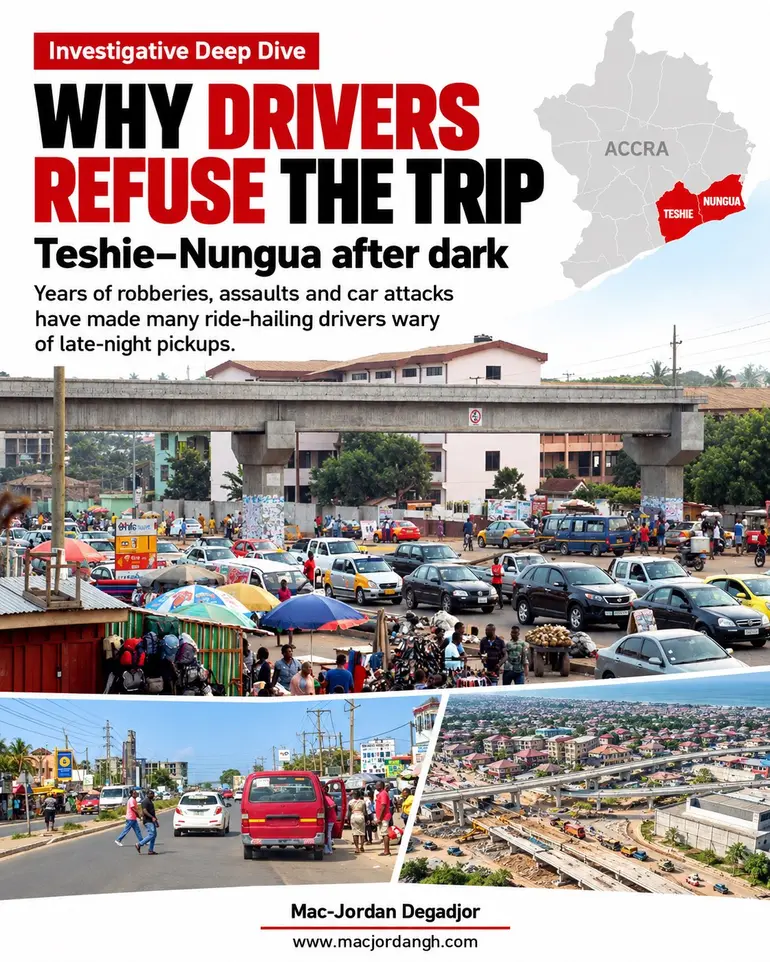

Safety concerns among ride-hailing drivers have resurfaced in parts of Teshie and across Accra, with some drivers reportedly becoming reluctant to accept late-night trips to unfamiliar or poorly lit locations.
The renewed discussion follows reports surrounding the death of Circle-based phone dealer Nana Yaw Kyere, popularly known as Terry or Dinero, who reportedly travelled to Teshie for a business transaction before communication with him was lost. His family later confirmed that he had been found dead, while investigations into the circumstances continued.
Against that background, accounts from some Uber, Bolt and Yango drivers have highlighted locations they say they approach with particular caution after dark.
Locations in Teshie-Nungua reportedly causing concern
The locations mentioned in recent reports include:
- Teshie Malik
- Teshie Agblezaa
- Teshie Market
- Teshie Mobil
- The LEKMA Hospital area
- Greda Estate
- Nungua Barrier
Reports attribute the concerns to incidents and experiences involving alleged robbery, phone snatching, assault and vehicle theft, as well as concerns about poorly lit or isolated roads.
However, these locations have not been officially designated by the Ghana Police Service as a definitive list of dangerous neighbourhoods. They reflect accounts attributed to drivers and reported incidents rather than an official crime ranking.
Teshie Mobil and LEKMA area
There is documented court reporting involving an alleged robbery of a Yango driver in Teshie.
According to the Ghana News Agency, two men were arraigned in February 2026 over an alleged robbery involving a Yango driver who had picked them up around Teshie Mobil. The prosecution alleged that the driver was robbed of his phone and GH¢1,500 during the journey toward the LEKMA Hospital area. Both accused persons pleaded not guilty and were granted bail.
The case is an allegation before the courts and should not be taken as evidence that everyone travelling through the area faces such a risk.
Other Accra roads flagged in safety reports
The concerns extend beyond Teshie.
Current UK government travel advice says local police have highlighted risks to vehicles on several Accra roads and areas, including:
- Teshie-Nungua Road
- Graphic Road
- George Walker Bush Highway
- Accra Mall Roundabout
- Awudome Cemetery Road
- Pokuase-Amasaman Road
- Labadi beach area
- GIMPA Road and surrounding areas
- Kokrobite beach area
The same advice says attacks involving vehicles have occurred and recommends keeping windows up and doors locked, while advising against travelling alone in taxis after dark.
An ASIRT Ghana road-safety review similarly identifies several of these Accra locations in connection with reported attacks on vehicles, including taxis.
Why night driving is a particular concern
The issue is not limited to one neighbourhood.
A 2026 academic study examining the experiences of 23 female ride-hailing drivers in Accra and Kumasi found that 19 participants, or 83%, reported avoiding night driving or particular neighbourhoods because of safety concerns. The concerns included robbery or assault, vehicle theft, unfamiliar areas and late-night driving in places with limited traffic or police presence.
The researchers did not establish a national list of dangerous neighbourhoods, nor did they conclude that Teshie as a whole is unsafe.
Drivers urged to take precautions
For drivers accepting trips after dark, practical precautions include checking the destination before accepting an unfamiliar journey, sharing trip details with a trusted person, keeping doors locked and windows up, and avoiding unnecessary stops in isolated areas.
Drivers should also remain alert when picking up or dropping off passengers, particularly where lighting and pedestrian activity are limited.
The UK’s Ghana travel guidance specifically recommends keeping vehicle doors locked and windows up because attacks on vehicles have been reported.
Teshie is not uniformly unsafe
The reports should not be interpreted as meaning that every part of Teshie or Nungua is dangerous.
Teshie-Nungua is a large, densely populated part of Accra where residents, businesses, commuters and ride-hailing passengers move around every day. The available evidence points instead to specific reported incidents and concerns about certain routes or circumstances, particularly late at night.
The recent discussion nevertheless highlights a broader safety challenge for drivers who work after dark and has renewed calls for improved street lighting, stronger police visibility and better protection for ride-hailing operators.
For drivers, the message is less about avoiding an entire community and more about exercising heightened caution when accepting unfamiliar late-night trips, particularly along poorly lit or isolated routes.