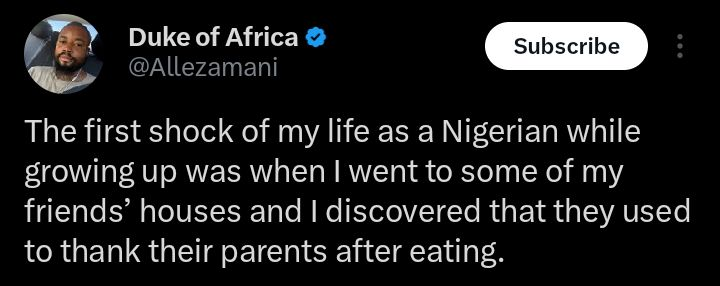

A man has ignited a firestorm of reactions on social media after boldly claiming that children who say “thank you” to their parents after being fed are behaving like slaves.
The controversial remark, which quickly went viral, has divided opinion across the internet, with thousands of users weighing in on the heated debate about parenting, gratitude, and family responsibilities.
According to the man, parents have a natural obligation to provide food, shelter, and care for their children. He argued that because these responsibilities are part of parenthood, children should not feel compelled to constantly express gratitude for receiving basic necessities.
“Only slaves say thank you to their parents after eating,” he reportedly stated, a comment that immediately triggered backlash from many social media users.
Critics were quick to condemn the statement, arguing that expressing appreciation is a sign of good manners and respect rather than submission. Many maintained that saying “thank you” helps foster humility, gratitude, and stronger family relationships regardless of whether parents are fulfilling their duties.
Others, however, partially agreed with the man’s viewpoint, suggesting that some parents use their financial support as a tool for control and repeatedly demand gratitude for carrying out responsibilities they willingly accepted by becoming parents.
The debate soon expanded beyond the original comment, with users discussing broader issues surrounding parenting expectations, cultural values, and the difference between appreciation and obligation.
Social Media Erupts
As reactions poured in, the statement became a trending topic, with many expressing disbelief at the comparison between gratitude and slavery. Others shared personal experiences about how being taught to appreciate even the smallest gestures had positively shaped their character.
While the comment continues to generate controversy, one thing is certain: the man’s bold claim has sparked a nationwide conversation about whether children should thank their parents for providing life’s basic necessities—or whether such gratitude should be freely given rather than expected.
Do you agree that parents should not expect thanks for fulfilling their responsibilities, or is gratitude an important value every child should learn?