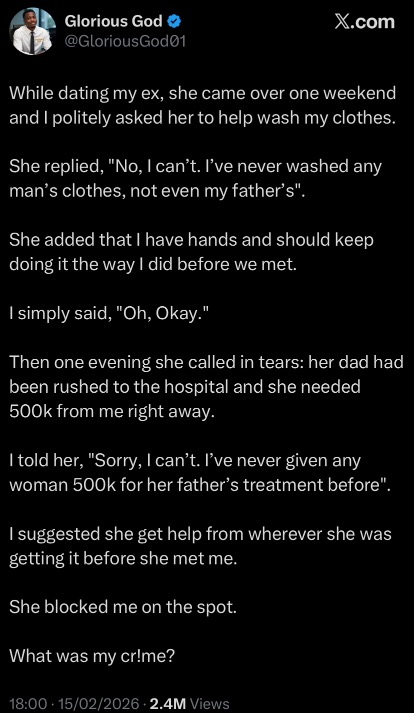


A storm of outrage and heated debate has erupted online after a man revealed he refused to give his ex-girlfriend ₦500,000 for her father’s medical treatment — and now he’s asking one burning question: “What was my crime?”

The unidentified man took to social media to share his side of the story, insisting he did nothing wrong by turning down the request. According to him, the relationship had ended, they had both moved on, and he felt no obligation to shoulder such a heavy financial responsibility.
But the internet? It had other ideas.
“You Could Have Helped!”
Within hours, social media users flooded the comment section, with many accusing him of being heartless and insensitive.
“Even if she’s your ex, you once loved her. You could have helped,” one user wrote.
Others argued that ₦500,000 — a significant sum — is not something anyone should feel entitled to demand from a former partner, especially after the relationship has ended.
Love, Loyalty… or Liability?
The man explained that the breakup wasn’t amicable and that they had cut ties completely. So when she reached out asking for half a million naira to support her father’s treatment, he said he was stunned.
“I was shocked. We’re no longer together. I have my own responsibilities. What was my crime?” he reportedly wrote.
That single line has since gone viral, fueling a fierce divide online.
Social Media Split Down the Middle
While some branded him “wicked” and accused him of lacking compassion, others defended his stance.
“An ex is an ex for a reason,” another commenter fired back. “He’s not her husband. He’s not her ATM.”
Supporters argue that generosity should come from willingness, not pressure — and certainly not obligation after a breakup.
Bigger Conversation: Are Exes Still Responsible?
The drama has sparked a larger debate: Do emotional ties create lasting financial responsibilities? Should past relationships come with lifelong expectations of support?
For many, the real issue isn’t the money — it’s the principle.
As the debate rages on, one thing is clear: in the court of public opinion, there are no easy verdicts.
But the man at the center of the storm is still asking the same question:
“What was my crime?”