

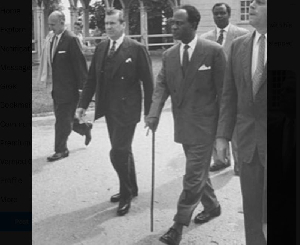
In an era long before media coaching, teleprompters, and carefully staged press briefings, one man mastered the art of visual storytelling without uttering a single instruction. Ghana’s founding leader, Kwame Nkrumah, didn’t just appear in photographs—he commanded them.

Observers and insiders alike have long marveled at how effortlessly Nkrumah seemed to control the lens. There were no audible cues, no visible signals, no dramatic gestures to photographers scrambling for the perfect shot. Yet, time and again, the images came out striking—powerful, composed, and deeply symbolic.
So how did he do it?
Those who watched him closely began to notice a pattern. Nkrumah possessed an almost theatrical awareness of presence. A slight tilt of the head, a deliberate pause before a handshake, a carefully timed glance into the distance—these subtle movements were not accidental. They were intentional, calculated, and brilliantly executed.
Photographers, often without realizing it, were being guided.
Rather than directing with words, Nkrumah used timing as his language. He understood the rhythm of the camera: when shutters clicked, when attention peaked, and when a moment could transform into history. By positioning himself just right—under the best light, at the perfect angle, in the most meaningful context—he ensured that every image told a story aligned with his vision.
It wasn’t manipulation. It was mastery.
In public gatherings, he would instinctively find the strongest visual center—whether standing beside key figures, addressing crowds, or inspecting projects. He knew exactly where history was being written and made sure he stood at its focal point.
Even in candid moments, there was nothing truly accidental. His posture remained poised, his expressions measured yet natural. The result? Photographs that looked spontaneous but carried the weight of deliberate symbolism.
This silent choreography gave Nkrumah a powerful advantage. While others reacted to the camera, he anticipated it. While others posed, he performed—quietly, subtly, effectively.
Decades later, those images remain etched in the national consciousness: a leader not just captured in history, but actively shaping how history would remember him.
And perhaps that is the most remarkable part of all.
Without raising his voice, without issuing commands, Kwame Nkrumah turned every photograph into a statement—proving that sometimes, the most powerful direction is the one never spoken.