Author: Daniel Sasu

  • Nationwide Mourning Begins — Iran Holds Public Tributes for Ayatollah Killed in February Attack

    Nationwide Mourning Begins — Iran Holds Public Tributes for Ayatollah Killed in February Attack

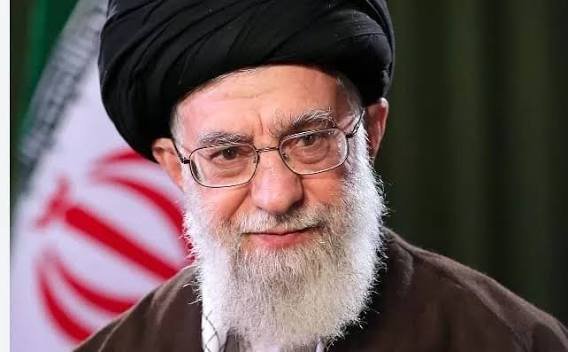
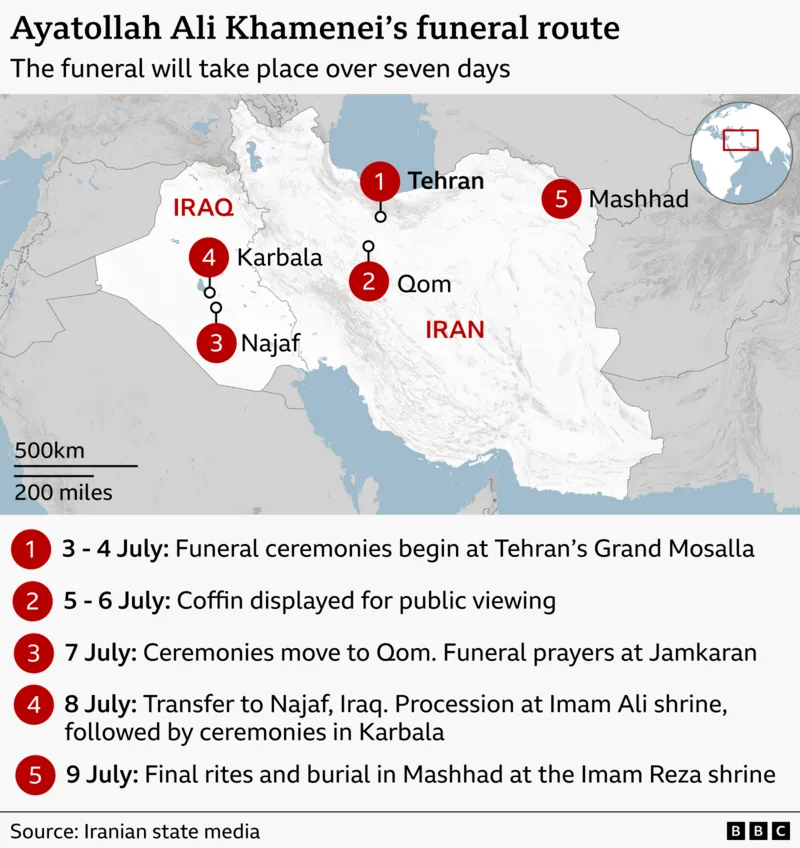
    A wave of public mourning has begun across Iran following official ceremonies commemorating an Ayatollah who was killed in an incident earlier in February, reigniting national grief and political reflection.

    State and religious authorities have launched organized remembrance events, with citizens gathering in major cities to pay tribute to the late cleric whose death had previously sparked widespread reactions across the country.
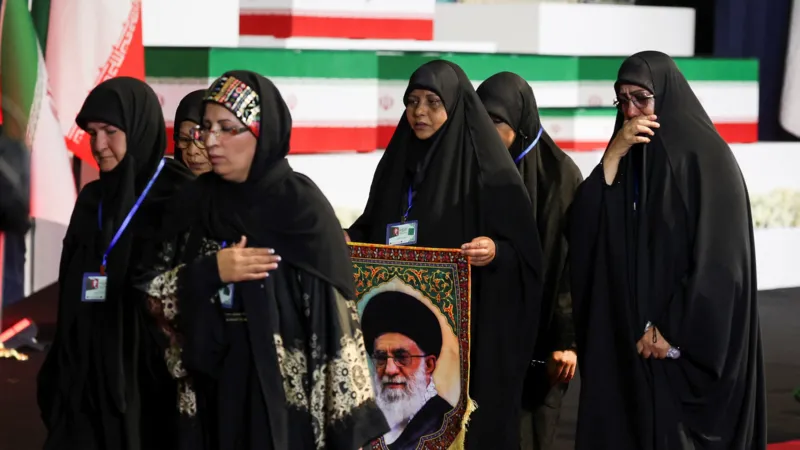
    The mourning activities include public processions, prayer gatherings, and memorial services held at mosques and religious centers, as communities reflect on the life and influence of the senior religious figure.

    Officials described the ceremonies as a moment of unity and national solidarity, emphasizing the Ayatollah’s role in religious scholarship and his contributions to public life.
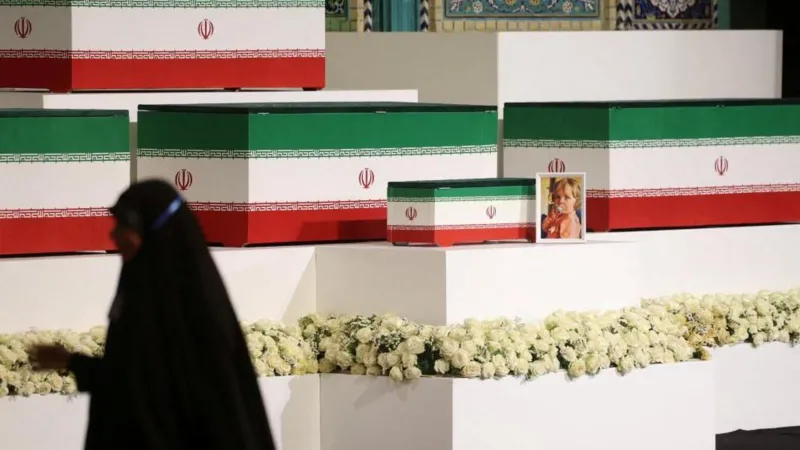
    Security has reportedly been heightened around major gathering points as large crowds participate in the commemorations, with authorities managing traffic and public order during the events.

    The February killing, which had already drawn significant attention at the time, is once again under public focus as citizens revisit the circumstances surrounding the incident and its broader implications.
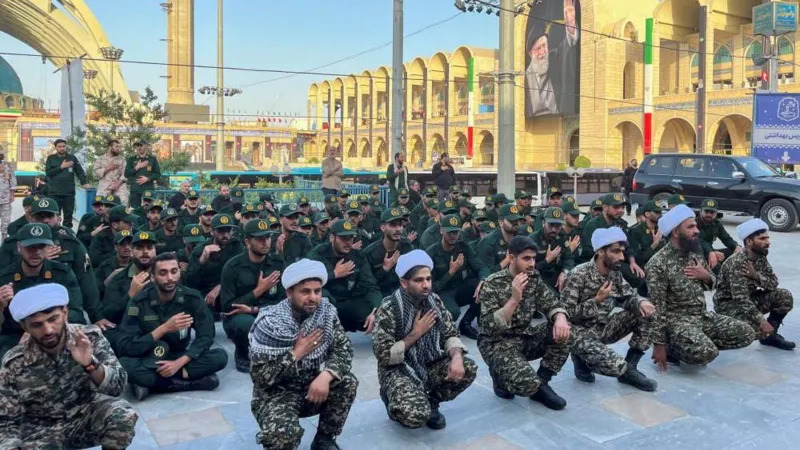
    As mourning continues, analysts say the renewed tributes could also carry political and social significance, reinforcing the enduring influence of religious leadership within Iran’s public sphere.

    The ceremonies are expected to continue over the coming days, with additional memorial events planned in various provinces as the nation collectively marks the loss.

  • What Really Wins Votes? New Study Reveals How Social Development Shapes Electoral Success in Ghana

    What Really Wins Votes? New Study Reveals How Social Development Shapes Electoral Success in Ghana

    A compelling new study has shed light on one of Ghana’s most pressing political questions: What do voters truly want? The findings suggest that development in key social sectors plays a significant role in influencing electoral outcomes across the country.

    The research explores the relationship between government investment in critical areas such as education, healthcare, social protection, and public infrastructure, and how these efforts shape voter perceptions and decisions at the ballot box.

    According to the study, citizens are more likely to reward governments that deliver tangible improvements in their daily lives, particularly through better access to quality education, healthcare services, employment opportunities, and essential public amenities.

    The findings indicate that while campaign promises and political messaging remain influential, visible development projects and improved public services often carry greater weight when voters assess the performance of political leaders.

    Researchers argue that sustained investment in the social sector not only improves living standards but can also strengthen public trust in government, potentially translating into increased electoral support during national and local elections.

    The study further highlights that voters are becoming increasingly discerning, placing greater emphasis on measurable development outcomes rather than partisan loyalty alone. This trend, experts say, reflects the growing demand for accountable leadership and results-driven governance.

    Political analysts believe the research offers valuable insights for policymakers and political parties preparing for future elections, emphasizing that meaningful investments in human development may prove to be one of the most effective strategies for earning public confidence.

    As Ghana’s political landscape continues to evolve, the study reinforces a clear message: voters are paying close attention to the impact of government policies on their everyday lives, and development in the social sectors could remain a decisive factor in determining electoral success.

  • “NPP MUST STRENGTHEN GRASSROOTS TO WIN 2028” — OSUMANU WARNS PARTY AS INTERNAL REORGANISATION DEBATE INTENSIFIES

    “NPP MUST STRENGTHEN GRASSROOTS TO WIN 2028” — OSUMANU WARNS PARTY AS INTERNAL REORGANISATION DEBATE INTENSIFIES

    A leading voice within the opposition has urged the New Patriotic Party (NPP) to urgently rebuild and strengthen its grassroots structures if it hopes to mount a successful comeback in the 2028 general elections.

    According to the commentator Osumanu, the party’s future electoral fortunes will depend heavily on how well it reconnects with its base, reorganises local branches, and restores confidence among rank-and-file supporters.

    CALL FOR RETURN TO GRASSROOTS POLITICS

    Osumanu argued that the party’s traditional strength has always been rooted in its grassroots mobilisation network, which he believes has weakened in recent times due to internal divisions and reduced engagement at the community level.

    He stressed that without a deliberate effort to rebuild these structures, the party risks losing its competitive edge in future elections.

    FOCUS ON UNITY AND REORGANISATION

    The statement adds to ongoing discussions within the party about unity, leadership direction, and strategic planning ahead of 2028.

    Political observers say such calls reflect broader concerns about internal cohesion and the need for a clear roadmap to regain public trust.

    ANALYSTS SAY CHALLENGE GOES BEYOND STRUCTURES

    Some analysts argue that beyond grassroots mobilisation, the party will also need to address issues such as messaging, policy direction, and voter perception if it hopes to stage a strong comeback.

    They note that modern elections are increasingly influenced by both traditional ground campaigns and digital engagement.

    LOOKING AHEAD TO 2028

    As political parties begin early positioning for the next electoral cycle, attention is already shifting toward strategy, restructuring, and rebuilding voter confidence.

    For Osumanu, however, the message is simple: no grassroots revival, no electoral victory in 2028.

  • Base Ghana Movement Embarks on Major Walk in Kumasi Today

    Base Ghana Movement Embarks on Major Walk in Kumasi Today

    The Base Ghana Movement is set to embark on a large-scale community walk in Kumasi today, drawing attention to its ongoing advocacy and mobilisation efforts across the country.

    The walk, expected to attract members, supporters, and sympathisers, forms part of the movement’s broader agenda to promote civic engagement, youth participation, and national development awareness.

    Organisers say the event will begin in key parts of Kumasi, with participants expected to march through designated routes while engaging the public on the movement’s message and objectives.

    The initiative has generated interest among residents, with some viewing it as a show of solidarity and growing influence, while others see it as part of a wider trend of civic groups using public demonstrations to amplify their presence.

    Security and traffic management arrangements are expected to be in place to ensure the smooth flow of the exercise, as large gatherings are anticipated along major streets.

    The Base Ghana Movement has recently increased its visibility through public engagements, and today’s walk in Kumasi is seen as another step in strengthening its grassroots connection.

    More updates are expected as the event unfolds.

  • MINORITY DEMANDS FULL PROBE INTO ANTI-FLOOD TASKFORCE AS QUESTIONS MOUNT OVER OPERATIONS

    MINORITY DEMANDS FULL PROBE INTO ANTI-FLOOD TASKFORCE AS QUESTIONS MOUNT OVER OPERATIONS

    The Minority in Parliament is calling for an urgent investigation into the activities of the government’s Anti-Flood Taskforce, amid growing concerns over transparency, effectiveness, and coordination in Ghana’s ongoing flood response efforts.

    The demand comes as several parts of the country continue to battle the impact of heavy rains and flooding, which have displaced residents, destroyed property, and strained emergency response systems.

    QUESTIONS OVER TASKFORCE OPERATIONS

    According to the Minority, there is a need to scrutinise how the taskforce has been deployed, including its mandate, resource allocation, and coordination with existing disaster management institutions.

    They argue that without proper oversight, there is a risk of duplication of roles and inefficient use of public funds at a time when affected communities urgently need support.

    CALL FOR ACCOUNTABILITY AND TRANSPARENCY

    The lawmakers are also seeking clarity on the structure of the taskforce, insisting that government must explain its operational framework and how it fits within broader national disaster response systems.

    They maintain that accountability is essential to ensure that relief efforts are both effective and properly managed.

    GOVERNMENT YET TO RESPOND OFFICIALLY

    As of now, there has been no detailed public response from the relevant authorities regarding the Minority’s request for a probe.

    However, officials involved in flood response efforts have previously defended ongoing interventions, describing them as necessary to complement existing disaster management mechanisms.

    FLOOD RESPONSE UNDER SCRUTINY

    The call for an investigation adds to rising public debate over Ghana’s preparedness for recurring floods, with critics questioning whether current strategies are sufficient to address long-term environmental and infrastructural challenges.

    BROADER PUSH FOR REFORM

    Beyond the taskforce itself, some observers say the issue reflects a wider need to strengthen coordination between agencies responsible for urban planning, drainage management, and emergency response.

    For the Minority, however, the priority is clear: no accountability, no effective flood response.

  • ASANTEWAA OPENS UP ON “NAUGHTY” SHS HABITS THAT COST HER DEARLY

    ASANTEWAA OPENS UP ON “NAUGHTY” SHS HABITS THAT COST HER DEARLY

    Popular Ghanaian social media personality Asantewaa has sparked conversation online after openly reflecting on what she described as “naughty” habits during her Senior High School days, admitting they later had consequences she still remembers.

    Her candid revelation has drawn mixed reactions, with fans praising her honesty while others debate the lessons behind her experience.

    A LOOK BACK AT SHS DAYS

    In her reflection, Asantewaa recounted her time in secondary school, describing moments of youthful mischief and decisions she now views differently with maturity.

    She suggested that some of her actions at the time were driven by peer influence, curiosity, and the typical pressures of adolescence.

    “I LEARNT THE HARD WAY” — HER ADMISSION

    The influencer admitted that certain behaviours she engaged in during SHS eventually “cost her dearly,” though she did not go into specific disciplinary or personal details.

    Her comments were framed as a cautionary reflection on how teenage decisions can have lasting impacts beyond school life.

    FANS REACT TO HER CONFESSION

    Social media users have since reacted to her story with a mix of humour, sympathy, and moral reflection.

    While some praised her for being transparent about her past, others used the opportunity to discuss discipline, guidance, and the challenges young people face in school environments.

    BROADER LESSON ON YOUTHFUL MISTAKES

    Her reflection has also reopened wider conversations about adolescent behaviour, peer pressure, and the importance of mentorship during formative school years.

    Educators and commentators online noted that such experiences are common, but often shape personal growth in significant ways.

    A MESSAGE OF GROWTH AND REFLECTION

    For Asantewaa, the story serves less as controversy and more as a personal reminder of growth.

    Her admission highlights a familiar truth many relate to: youthful mistakes often become the foundation for future maturity.

  • “Forget Master’s Degree, Use the Money for BBL” — Ajagurajah Sparks Debate With Bold Advice to Women

    “Forget Master’s Degree, Use the Money for BBL” — Ajagurajah Sparks Debate With Bold Advice to Women

    Ajagurajah has triggered widespread reactions online after advising women to reconsider spending on higher education and instead channel their resources into cosmetic procedures such as Brazilian Butt Lift (BBL).

    In a statement that has since gone viral on social media, the controversial spiritual leader suggested that pursuing a master’s degree may not always yield immediate financial returns, arguing that some women might benefit more—socially or economically—from investing in physical appearance enhancement.

    The comment quickly divided opinion across online platforms, with many users expressing shock at the comparison between academic advancement and cosmetic surgery.

    Critics described the advice as misleading and harmful, arguing that education remains one of the most reliable long-term investments for personal and professional growth. Others also raised concerns about the promotion of body modification procedures, which carry potential medical risks and long-term health implications.

    However, some supporters interpreted his remarks as commentary on modern societal priorities, where appearance and social perception are often linked to opportunities in entertainment, influencing, and relationships.

    The debate has since expanded into broader discussions about women’s empowerment, education choices, financial priorities, and the growing influence of cosmetic surgery culture among young people.

    As reactions continue to pour in, the controversial statement has once again placed Ajagurajah at the center of national online discourse.

  • “I’M GETTING OLD!” — EMOTIONAL MOMENT AS LADY BREAKS DOWN IN TEARS, BEGS FATHER FOR HUSBAND

    “I’M GETTING OLD!” — EMOTIONAL MOMENT AS LADY BREAKS DOWN IN TEARS, BEGS FATHER FOR HUSBAND

    Viral — A deeply emotional scene has sparked widespread reactions online after a lady was seen tearfully pleading with her father, expressing frustration over her unmarried status and saying she feels time is slipping away.

    In the widely circulated clip, the young woman broke down in tears while speaking to her father, lamenting her situation and saying, “I’m getting old,” as she asked for help in finding a husband.

    The emotional moment has triggered intense debate on social media about marriage pressure, societal expectations, and the emotional burden many young women face regarding relationships and timelines for settling down.

    Some viewers sympathized with her distress, describing the moment as a reflection of real societal pressures that often weigh heavily on individuals as they age without partners.

    Others, however, argued that such expectations are increasingly outdated, emphasizing that marriage should not be rushed due to age pressure but entered into with readiness, compatibility, and emotional stability.

    The video has since gone viral, with users sharing mixed reactions ranging from empathy and encouragement to criticism of societal norms that place urgency on marriage.

    As discussions continue, the clip has become another flashpoint in broader conversations about family expectations, personal timelines, and the evolving definition of fulfillment in modern relationships.

  • “Pound Fufu in 2026? No Way!” — Lady Shares How Husband’s Elder Brother Allegedly Rejected Three Meals She Cooked for Him

    “Pound Fufu in 2026? No Way!” — Lady Shares How Husband’s Elder Brother Allegedly Rejected Three Meals She Cooked for Him

    A woman has sparked heated reactions online after recounting an uncomfortable experience involving her husband’s elder brother, who allegedly rejected three different meals she prepared for him during a visit.

    According to her narration, what began as a simple gesture of hospitality quickly turned into a tense and embarrassing situation after the man reportedly refused each of the dishes served to him.

    She claims the situation escalated further when he questioned the type of food offered, reportedly reacting with disbelief at traditional meals such as pounded fufu, which he allegedly dismissed in a manner she found insulting.

    “Pound fufu in 2026?” he is said to have remarked, a comment that has since triggered widespread debate online over respect, cultural expectations, and hospitality within extended families.

    The lady explained that she had prepared multiple options in an attempt to accommodate his preferences, but each was allegedly turned down, leaving her frustrated and humiliated in her own home.

    Her account has since gone viral, with social media users divided over the incident—some criticizing the brother-in-law’s attitude as disrespectful, while others argue that guests should be free to express food preferences without being judged.

    The story has also reignited conversations about family dynamics in marriage, especially the tensions that can arise between in-laws and spouses over expectations of hospitality and respect.

    As reactions continue to pour in, many users are calling for calm and mutual understanding in handling such domestic disputes, while others continue to debate whether the reaction was justified or excessive.

    For now, the viral account remains a trending talking point, reflecting how everyday household experiences can quickly escalate into wider cultural conversations online.

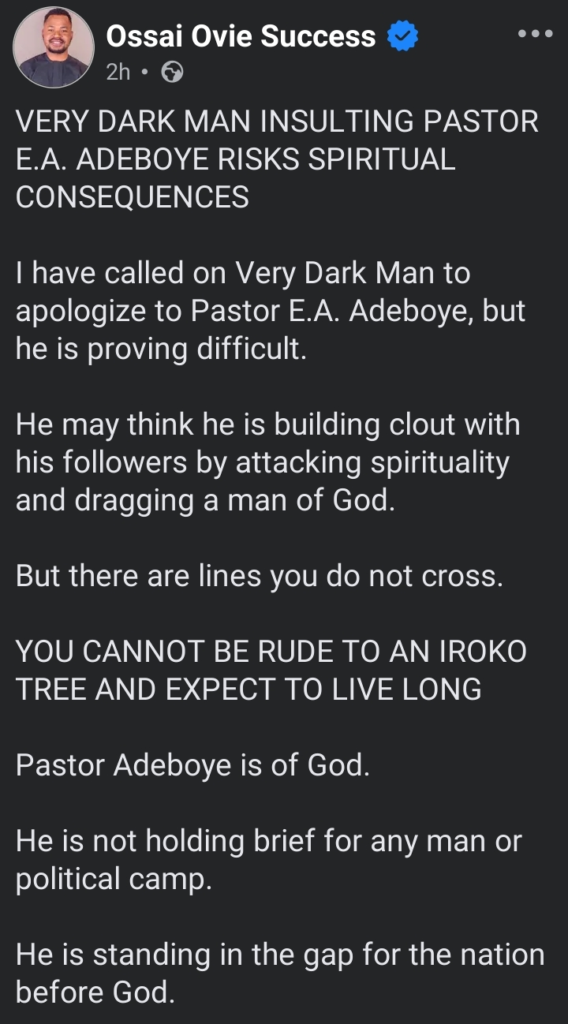
  • “VERYDARKMAN INSULTING PASTOR ADEBOYE RISKS SPIRITUAL CONSEQUENCES” — GOVERNOR’S AIDE DEMANDS APOLOGY

    “VERYDARKMAN INSULTING PASTOR ADEBOYE RISKS SPIRITUAL CONSEQUENCES” — GOVERNOR’S AIDE DEMANDS APOLOGY

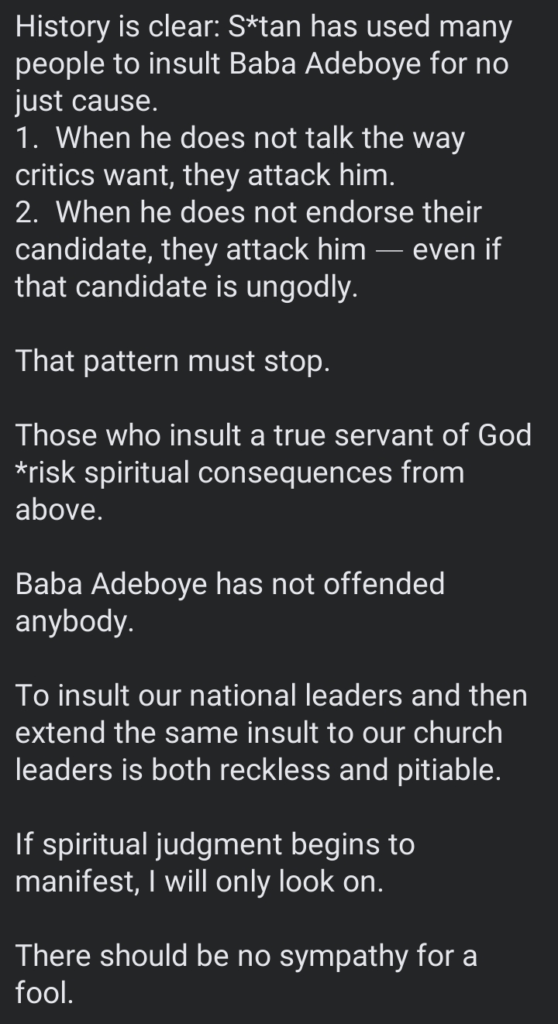
    A political aide to the Delta State Governor has sparked controversy after warning that comments made by activist VeryDarkMan about respected cleric Enoch Adeboye could carry “spiritual consequences,” while also demanding an immediate public apology.

    The remarks come amid growing online debate over VDM’s recent criticism of religious leaders and their perceived silence or stance on national issues.

    AIDE WARNS AGAINST “DISRESPECTING SPIRITUAL AUTHORITY”

    The governor’s aide argued that public criticism directed at Pastor Adeboye crosses a sensitive line, insisting that spiritual leaders should be treated with respect regardless of political or social disagreements.

    He further suggested that insulting religious figures could have consequences beyond public backlash, referencing what he described as spiritual implications tied to such conduct.

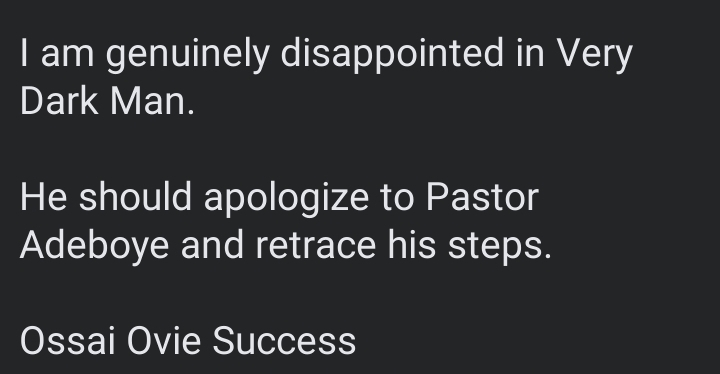
    CALL FOR PUBLIC APOLOGY

    The aide has called on VDM to retract his statements and issue a public apology, warning that continued attacks on respected clerics could deepen tensions between religious communities and social commentators.

    His comments have added a new layer to an already heated national conversation involving activism, religion, and free speech.

    VDM’S CRITICISM STILL AT THE CENTER OF DEBATE

    The controversy stems from VDM’s outspoken commentary on national issues, including his criticism of prominent figures, which has repeatedly drawn both support and backlash online.

    Supporters say he is holding powerful voices accountable, while critics argue that his tone often crosses into disrespect.

    RELIGION, POLITICS AND FREE SPEECH COLLIDE

    The latest exchange highlights the growing friction between digital activism and traditional authority structures in Nigeria, particularly when religious leaders are involved.

    Observers note that debates of this nature often escalate quickly due to the emotional and cultural weight attached to religious leadership.

    SOCIAL MEDIA DIVIDED

    Reactions online remain sharply split, with some agreeing that religious figures deserve special respect, while others insist that no public figure should be exempt from scrutiny.

    As the debate continues, neither VDM nor Pastor Adeboye has publicly responded to the aide’s latest remarks.

    For now, the controversy underscores a familiar tension in the digital age: where free speech ends and respect begins remains deeply contested.