In a jaw-dropping revelation that’s sending football fans into a frenzy, viral sensation iShowSpeed didn’t hold back while visiting Cristiano Ronaldo’s mansion, declaring, “I don’t like Messi because he’s short and trash, Ronaldo is better!”
The controversial streamer’s bold comments have instantly ignited the ultimate Messi vs. Ronaldo debate online, with social media exploding in memes, hot takes, and fan warfare. Sources say iShowSpeed was seen laughing and bragging alongside the Portuguese superstar, fueling speculation about a secret new bromance—or a strategic stunt to stir the internet pot.
Fans are divided: #TeamRonaldo supporters are cheering iShowSpeed’s “honest truth,” while Messi loyalists are calling it the ultimate disrespect. Either way, the football world won’t stop talking about it anytime soon.
Stay tuned: this digital drama might just spark the wildest online football feud of the year.
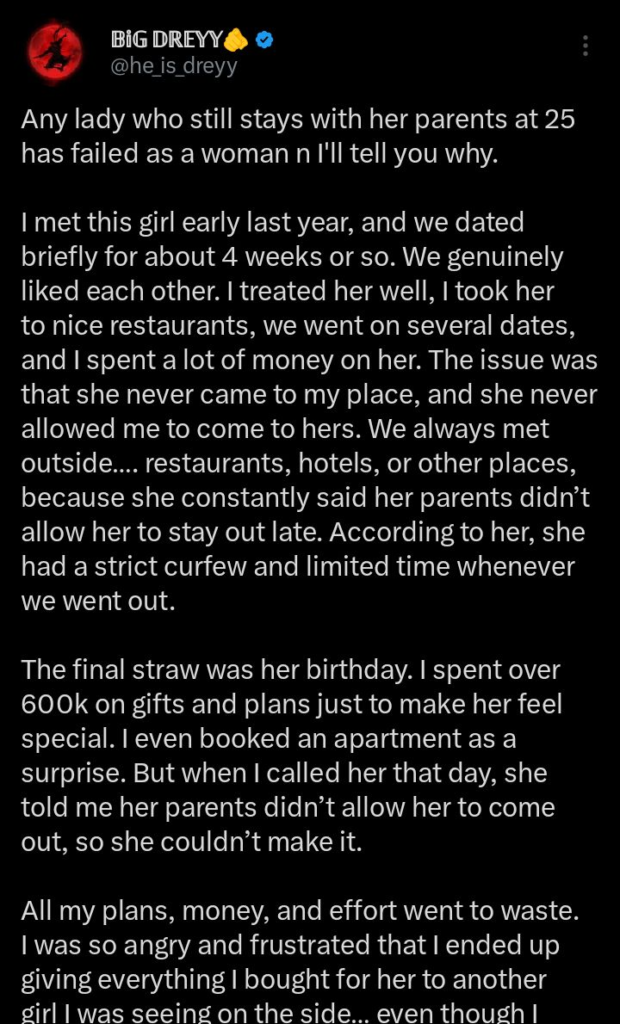
In a blunt and controversial post that has since gone viral, the man declared: “Any lady still living with her parents at 25 has failed.”
The words were met with immediate backlash, with thousands condemning what they called toxic, judgmental, and outdated thinking.
Supporters of the post argued it was a wake-up call about personal responsibility and financial independence, claiming that moving out by mid-20s shows maturity and readiness for serious relationships.
“I moved out at 22 and never looked back. He’s right about independence,” one user commented.
But critics were far louder, labeling the statement sexist and unrealistic, noting cultural, economic, and personal factors that might delay leaving the family home.
“Wow, this guy really thinks a woman’s worth is measured by rent checks and zip codes,” one viral tweet read. “Some of us are saving, studying, or helping our parents. Not ‘failing,’ just living,” another fired back
The explosive remark has reignited conversations around gender expectations, societal pressures, and the definition of success for women, with experts warning that such statements reinforce harmful stereotypes.
Psychologists weighed in, saying that financial independence is important, but personal growth, career planning, and emotional readiness are far more nuanced than a simple age-and-address checklist.
Since the confession, the post has racked up thousands of shares, debates, and memes — with hashtags like #FailingAt25 trending on Twitter.
Whether viewed as harsh truth or toxic nonsense, one thing is clear: this man’s bold claim has touched a nerve — and the internet isn’t letting it slide.
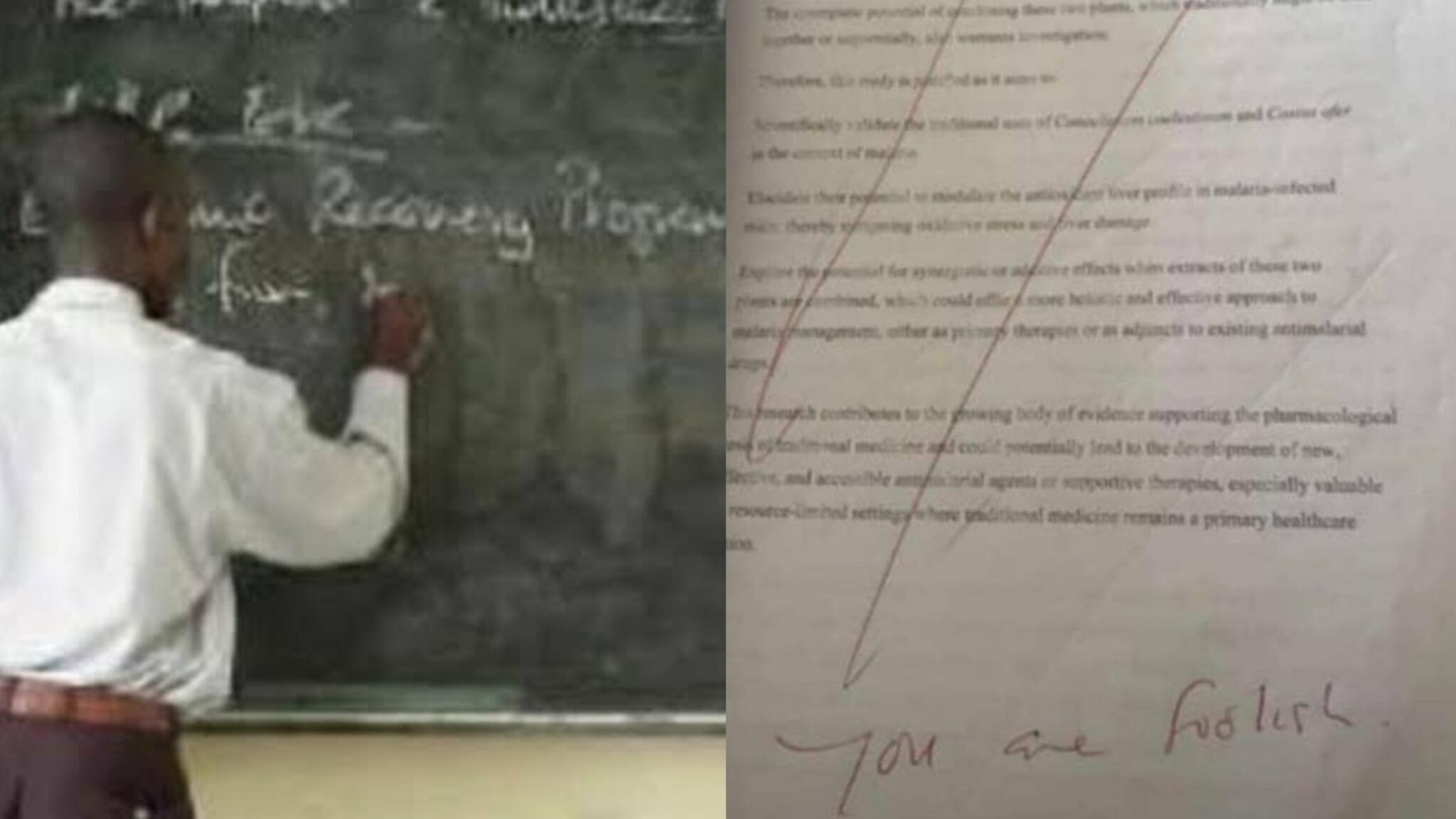
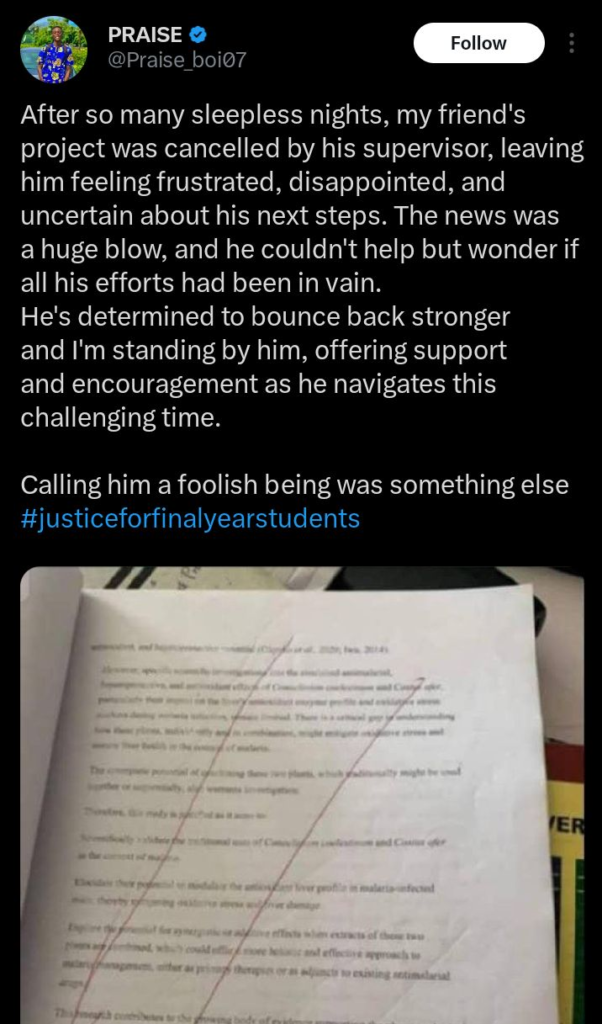
A shocking confrontation between a university lecturer and a final-year student has gone viral, sparking a firestorm of debate across social media.
According to reports, the lecturer abruptly canceled the student’s final-year project after a tense exchange in which the faculty member reportedly told the student: “You are foolish.” The blunt remark left the student stunned and classmates in disbelief.
The project, which the student had been developing for months, was suddenly deemed unacceptable, leaving them with little time to salvage their final assessment. Eyewitnesses claim the incident escalated quickly, with the lecturer criticizing both the approach and the student’s understanding of the subject.
Social media erupted almost immediately. Students, alumni, and concerned users flooded platforms with messages condemning the lecturer’s alleged behavior, calling the incident “unprofessional,” “humiliating,” and “a blatant abuse of authority.” Some argued it raises larger questions about academic pressure and the mental health of students facing high-stakes assessments.
Supporters of the lecturer, however, defended the action, claiming that accountability and rigorous standards are essential in higher education — even if the delivery seems harsh.
The incident has sparked calls for clearer policies on student-lecturer interactions and proper channels for grievance redress. Meanwhile, the student at the center of the storm has remained mostly silent but reportedly plans to appeal the decision.
This dramatic clash has captured nationwide attention, reigniting debates about respect, professionalism, and the fine line between discipline and humiliation in academia.
In a bold and controversial message now making the rounds on social media, the woman cautioned women to protect their independence at all costs, insisting that giving up one’s work or livelihood for love can be a dangerous gamble.
“Don’t stop your work for any man,” she warned, before adding the statement that truly set the internet ablaze: “Men are manipulative by nature.”
A MESSAGE THAT DIVIDED THE INTERNET
Her words immediately triggered intense reactions, splitting opinion down the middle.
Supporters hailed the message as a wake-up call, saying too many women have sacrificed careers, financial stability, and personal growth for relationships that later fell apart.
“Love shouldn’t cost you your independence,” one supporter commented. “I wish someone told me this years ago,” another added.
BACKLASH AND BLOWBACK
Critics, however, slammed the statement as overgeneralized and inflammatory, arguing that labeling all men as manipulative fuels gender hostility and ignores healthy, supportive partnerships.
“Not all men are like this,” many countered, accusing the speaker of projecting personal experiences onto an entire gender.
THE BIGGER PICTURE
Beyond the controversy, the viral message has reopened a broader discussion about power, dependency, and self-preservation in relationships — particularly for women navigating marriage, career decisions, and financial security.
While opinions remain sharply divided, the statement has undeniably struck a chord.
"Some men are manipulåtive. A woman without money is a woman without a voice. Your husband may first tell you to stay at home and not work, promising to take care of everything. But soon, when you ask him for money, the whole story changes"👀
A woman’s emotional confession has struck a nerve online after she revealed how listening to her friends’ advice led to one of the most painful mistakes of her life.
In a deeply personal story shared on social media, the lady recounted how everything seemed harmless at first. Encouraged by close friends who claimed they “knew better,” she made a relationship decision she believed would lead to happiness — but instead opened the door to regret, heartbreak, and lasting emotional scars.
“One of my biggest mistakes started the moment I stopped listening to my own instincts,” she admitted.
According to her, the advice sounded convincing at the time. Friends urged her to be patient, to compromise, to ignore red flags, and to trust that “things would get better.” Wanting to fit in and fearing she might be overreacting, she followed their guidance — even when her heart quietly warned her otherwise.
What followed, she says, was a relationship filled with disappointment, emotional exhaustion, and lessons learned the hard way. By the time she realized the damage, she was already deeply invested and struggling to find her way out.
Her story has sparked widespread conversation, with many readers admitting they had made similar choices after prioritizing friends’ opinions over personal intuition. Some praised her courage for speaking out, while others shared their own painful experiences in the comments.
Today, she offers a simple but powerful message: advice can be helpful, but no one lives with the consequences except you.
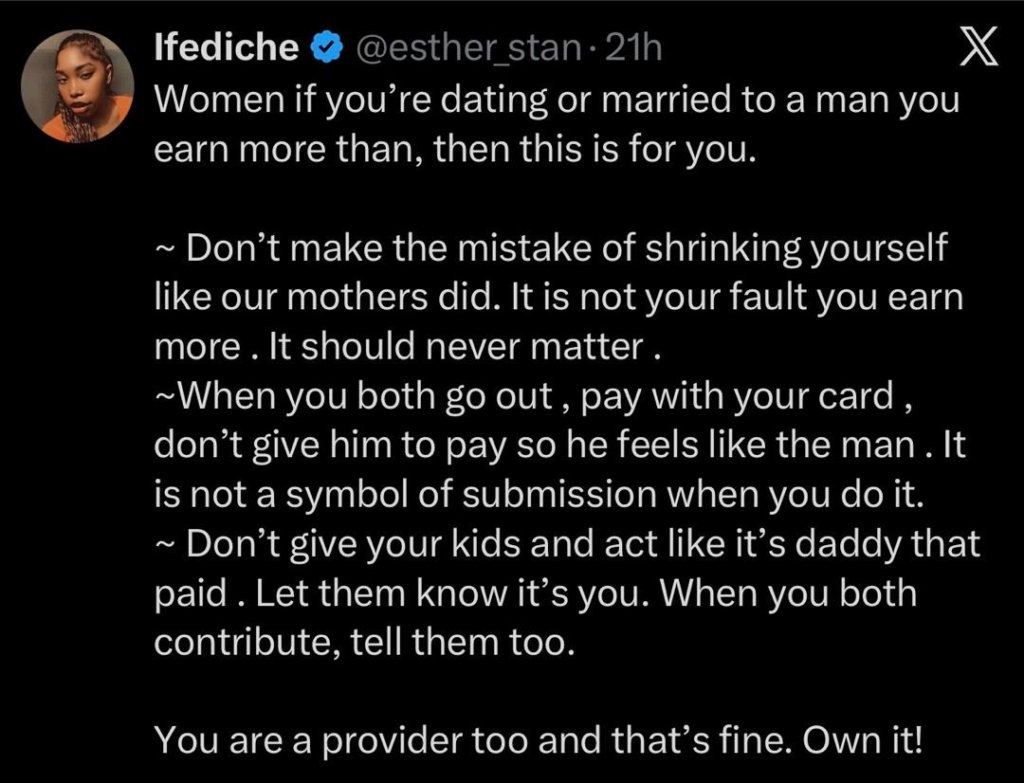
“Don’t shrink yourself,” the lady declared in a now-viral message that has set social media ablaze. Speaking directly to women who out-earn their partners, she challenged them to own their success unapologetically instead of dimming their light to protect fragile egos.
Her message struck a nerve — and not quietly.
According to her, many women are pressured to downplay promotions, hide pay raises, or act smaller at home just to keep peace in their relationships. “If your success makes someone uncomfortable,” she implied, “that discomfort is not your responsibility.”
SUPPORTERS CHEER: ‘SAY IT LOUDER!’
Thousands of women rallied behind the statement, praising it as long-overdue truth in a world that still ties masculinity to income.
“This is healing for women who’ve been made to feel guilty for winning,” one commenter wrote. “Love shouldn’t require self-erasure,” another added.
CRITICS PUSH BACK
Not everyone agreed. Critics argued that relationships thrive on compromise and emotional intelligence, not financial comparisons, warning that such advice could fuel ego clashes rather than harmony.
“Marriage isn’t a competition,” one opposing voice said. “Money shouldn’t be weaponized.”
A DEEPER CONVERSATION
Beyond the viral soundbite, the debate has opened up broader questions about gender roles, power dynamics, and modern relationships — especially as more women become primary earners worldwide.
Should success be softened to preserve love? Or should partnerships evolve to celebrate ambition on both sides?
For now, one thing is clear: “Don’t shrink yourself” has become more than advice — it’s a rallying cry.
After four long years on the frontlines of life and death, an intensive care unit (ICU) nurse has shared a chilling revelation about her experiences caring for patients in their final moments — and her words are sending shivers down spines.
In an emotional account that has gripped social media, the nurse revealed that patients nearing death often repeat the same haunting words, regardless of age, background, or circumstance. According to her, the pattern is so consistent it has become impossible to ignore.
“I’ve heard it over and over again,” she said. “Different faces, different stories — but the same regrets.”
The nurse explained that in their final hours, many patients don’t talk about money, success, or material achievements. Instead, they speak about love they didn’t show, time they didn’t spend with family, apologies they never made, and lives they felt they were too busy to truly live.
Some ask for loved ones they pushed away. Others whisper regrets through oxygen masks, realizing too late what truly mattered.
Her confession has sparked deep reflection online, with many readers admitting it forced them to rethink their priorities. “This scared me,” one commenter wrote. “I don’t want to be saying those same words one day.”
The ICU nurse says the experience has permanently changed how she lives her own life. She no longer takes moments for granted and urges people to love harder, forgive quicker, and stop postponing happiness.
An IUC nurses says in her 4 years of working, everyone who dies always say the same thing 🎧👂🏾 pic.twitter.com/KcGrFDHnUJ
In a candid and emotionally charged confession, the young woman — raised in the heart of the church and shaped by years of life in the pulpit’s shadow — stunned listeners by admitting she does not want to marry a pastor, despite being the daughter of one.
“I know it sounds strange,” she began, bracing for backlash, “but this is my truth.”
She then laid out four powerful reasons behind her decision — reasons that have struck a nerve with many who know the unseen pressures of church life.
1. A Marriage Shared With the Whole Church
According to her, marrying a pastor often means never having a private marriage. Every move, argument, outfit, and decision becomes public property, scrutinized by congregants who believe they have a say in the pastor’s home.
“You’re not just a wife,” she explained. “You become a public figure overnight — whether you’re ready or not.”
2. The Weight of Unrealistic Expectations
From being the “perfect pastor’s wife” to living under constant moral surveillance, she says the pressure is relentless. Any misstep can quickly turn into gossip — or worse, a sermon illustration.
“You’re expected to be flawless, prayerful, patient, and pleasant all the time,” she said. “That’s exhausting.”
3. Ministry Before Marriage
Growing up, she watched ministry consistently come before family, with emergencies, church politics, and late-night calls taking priority over birthdays, holidays, and personal moments.
“I want a partner who can choose me sometimes,” she admitted. “Not one who always has to choose the church.”
4. Emotional Burnout Is Real
Finally, she pointed to the emotional toll pastors often carry — counseling others through crises while silently battling their own struggles.
“I’ve seen the burnout. I’ve seen the loneliness,” she said. “Love alone doesn’t always fix that.”
A CONVERSATION THAT HIT A NERVE
Her honesty has sparked widespread debate online. Some praised her courage for saying what many think but never voice, while others accused her of misunderstanding the calling of ministry.
Yet for many pastor’s kids and church insiders, her words rang painfully true.
A bold and controversial message has sent social media into a frenzy after a woman openly advised fellow ladies to never give men free access to their time, attention, or bodies without receiving something in return.
In a viral statement that has sparked heated debates, the outspoken lady urged women to “put a price tag” on themselves, insisting that no man deserves to “chill” with a woman unless he is offering tangible benefits — whether financial, emotional, or material.
According to her, women who allow men to enjoy their company for free are “selling themselves short” and wasting value that should be protected and rewarded. She argued that men understand value only when it comes with a cost, and women should stop feeling guilty about demanding something in return.
“Nothing is free,” she reportedly said, emphasizing that time, beauty, energy, and intimacy all come at a price.
While supporters applauded her for empowering women to know their worth and set clear boundaries, critics slammed the advice as dangerous, transactional, and reducing relationships to business deals. Some accused her of promoting materialism, while others warned it could damage genuine emotional connections.
Despite the backlash, the statement has refused to fade quietly. Screenshots, reactions, and fiery opinion pieces continue to flood timelines, proving that the message struck a nerve.
Santa Clara, CA — Just minutes after Bad Bunny electrified millions with a star-studded, history-making Super Bowl LX halftime performance, R&B firebrand Chris Brown lit up social media with a brazen post that has fans and critics talking non-stop.
Brown, who has never headlined a Super Bowl show, dropped this cryptic bomb on his Instagram story: “I THINK IT’S SAFE TO SAY… THEY NEED ME! 😏” — a winking-emoji flex that many saw as a direct shade at Bad Bunny’s landmark night.
The timing couldn’t have been sharper: Bad Bunny had just wrapped a Spanish-language halftime spectacle that brought the house down with hits like “Tití Me Preguntó,” VIP guest turns from Cardi B, Lady Gaga and Ricky Martin, and a vibrant tribute to Latin culture that lit up Levi’s Stadium — and screens worldwide.
CULTURE CLASH AT CENTER STAGE
While millions celebrated Bad Bunny’s historic headline performance — the first Latino solo artist to dominate the Super Bowl halftime show and do it primarily in Spanish — Brown’s curt post ignited a fierce backlash and fierce debate online.
On one side, fans praised Bad Bunny’s high-energy, culturally resonant set as one of the most memorable halftime showcases ever. On the other, Brown’s shade sparked a flurry of reactions — from supporters calling for him to get his own halftime slot, to critics blasting the jab as petty and self-serving.
THE BACKDROP: A NIGHT OF ICONIC MOMENTS
Bad Bunny’s Super Bowl show wasn’t just music — it was a cultural moment. Packed with surprise cameos, pulsating visuals, and a message of unity that reverberated across social media and beyond, the artist delivered one of the most talked-about halftime gigs in years.
Now, as the dust settles on football’s biggest night, the buzz isn’t just about who won the game — it’s about whether Brown’s bold claim has set the stage for next year’s halftime rivalry.