Author: Daniel Sasu

  • 99% of Men Stop Kissing Their Wives After Marriage! — Woman Sparks Viral Outrage Online

    99% of Men Stop Kissing Their Wives After Marriage! — Woman Sparks Viral Outrage Online

    A bold claim from a woman has ignited social media, sending men and women into a heated debate about love, intimacy, and married life. According to her, the overwhelming majority of men—she insists as much as 99%—stop showing affection to their wives through kissing once they tie the knot.

    Her statement, shared in a viral post, didn’t just ruffle feathers—it set off a storm of reactions. Many women flooded the comment section, sharing frustration over dwindling displays of affection in long-term marriages. Some backed her claim, lamenting the romantic shift that seems to come after the wedding vows.

    Men, on the other hand, were quick to push back. Some dismissed her observation as an exaggeration, arguing that affection varies widely from couple to couple. Others admitted that the pressures of work, daily stress, and routine can unintentionally lead to a drop in romantic gestures.

    Relationship experts weighed in, noting that physical affection often declines over time if not consciously maintained, and that communication and effort are crucial to keeping intimacy alive.

    The post has now sparked a viral conversation about love after marriage, with users debating whether this is a harsh reality or just a stereotype blown out of proportion. Regardless, one thing is clear: the discussion on marital romance shows no signs of slowing down.

  • “My Eyes First Blur!” Woman Cries Out as ₦110,000 Vanishes Overnight Over ‘Free’ COVID-19 Loan

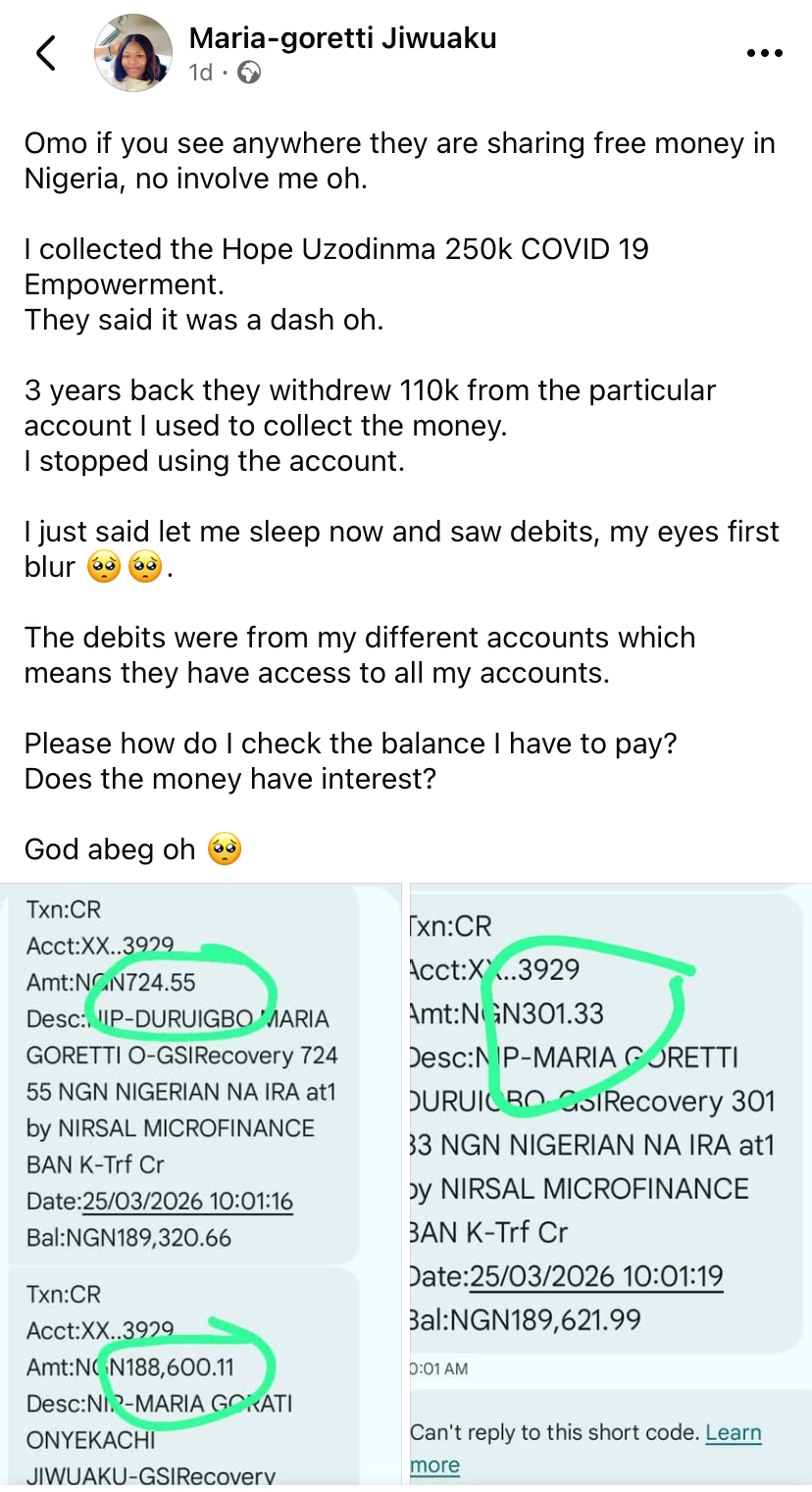
    “My Eyes First Blur!” Woman Cries Out as ₦110,000 Vanishes Overnight Over ‘Free’ COVID-19 Loan

    A shocking financial horror story has gone viral as a Nigerian woman revealed how ₦110,000 mysteriously disappeared from her bank account, all over a COVID-19 loan she believed was completely free

    The Moment of Shock

    In a dramatic social media post, the distressed lady described the exact moment she realized her money was gone:

    “My eyes first blur… I couldn’t believe it!”

    What she thought would be a simple financial boost to help navigate pandemic challenges quickly turned into a nightmare, leaving her stunned and angry.

    The ‘Free Loan’ That Cost a Fortune

    The woman claimed she took out a COVID-19 relief loan advertised as interest-free and non-repayable, only to later discover automatic deductions draining her account.

    According to her account, the terms were either hidden, misrepresented, or misunderstood, turning what she thought was a lifeline into a financial trap.

    Social Media Explodes

    Her post has ignited heated discussions online:

    • Supporters empathized with her shock and frustration, warning others to check loan terms carefully.
    • Critics suggested she should have fully read the fine print before borrowing.
    • Observers saw it as yet another cautionary tale about the dangers of quick, “easy” loans.

    The Larger Warning

    Financial experts have long cautioned that even so-called “emergency” or “relief” loans often come with hidden charges or repayment obligations. This incident has put millions on notice: nothing that looks free online truly is.

    As the story continues to trend, one thing is certain—what started as a hope for assistance has turned into a viral tale of panic, regret, and financial heartbreak.

    “My eyes first blur” – Lady cries out as N110k disappears from her account over COVID-19 loan she thought was ‘free’

  • “I Hid Behind Three Bras!” — Waje’s Painful Confession on Body Insecurity and Her Powerful Rise to Self-Love

    “I Hid Behind Three Bras!” — Waje’s Painful Confession on Body Insecurity and Her Powerful Rise to Self-Love

    Nigerian music powerhouse Waje has made a deeply personal revelation that’s striking a chord with fans everywhere — admitting she once wore three bras at once to cope with her body insecurities.

    In a candid and emotional disclosure, the soulful vocalist opened up about the struggles she faced growing up, battling self-doubt and discomfort with her appearance. According to her, the pressure to fit into society’s narrow beauty standards pushed her to extreme measures just to feel confident.

    “I used to wear three bras,” she revealed, describing how she tried to reshape her body to meet expectations and avoid criticism. Behind the glamour and powerful voice was a young woman grappling with insecurity and the fear of not being “enough.”

    But her story doesn’t end in struggle — it transforms into one of growth and empowerment. Over time, Waje began to embrace her natural body, shedding not just the extra layers of clothing, but also the weight of societal judgment.

    Today, she stands as a symbol of self-acceptance, encouraging others to love themselves unapologetically. Her journey from insecurity to confidence is inspiring many to rethink their own relationship with body image.

    The revelation has sparked widespread conversations online, with fans praising her honesty and courage. For many, it’s a reminder that even the most confident-looking celebrities have faced silent battles — and that true confidence comes from within.

    As reactions continue to pour in, Waje’s message is loud and clear: self-love isn’t instant — it’s a journey, and one worth taking.

  • “We Lost My Mother Too…” — Sister of Ochanya Ogbanje Reveals Heartbreaking Aftermath of Her Death

    “We Lost My Mother Too…” — Sister of Ochanya Ogbanje Reveals Heartbreaking Aftermath of Her Death

    In a deeply emotional and painful revelation, the sister of Ochanya Ogbanje has opened up about the devastating ripple effects that followed the young girl’s tragic death—sharing that the family didn’t just lose Ochanya, but their mother as well.

    Speaking through tears, she recounted how their mother was completely shattered after Ochanya’s passing, unable to cope with the trauma, grief, and public attention that followed the highly publicized case. According to her, the once-strong woman slowly broke down under the weight of loss and heartbreak.

    “We didn’t just lose Ochanya… we lost our mother too,” she said, describing a home that was never the same again.

    Ochanya’s death had already sent shockwaves across Nigeria, sparking outrage and calls for justice. But behind the headlines, the family was battling a silent war—grief that consumed them day by day. Her sister revealed that their mother became withdrawn, emotionally drained, and deeply affected by the tragedy, ultimately leading to her passing.

    The story paints a haunting picture of how one tragic incident can tear through an entire family, leaving lasting scars that go far beyond what the public sees.

    Ochanya’s case had once ignited national conversations about abuse, justice, and protection for vulnerable children. Now, this new revelation adds another painful layer—showing that the true cost of the tragedy extended far beyond a single life.

    As the family continues to mourn, their story stands as a sobering reminder: some wounds never truly heal, and for them, the loss was doubled in the most heartbreaking way imaginable.

  • Church Girl Doesn’t Mean Wife Material! — Man’s Blunt Warning to Men Ignites Heated Debate

    Church Girl Doesn’t Mean Wife Material! — Man’s Blunt Warning to Men Ignites Heated Debate

    A firestorm of reactions has erupted online after a man dropped a controversial piece of advice that’s turning heads and raising eyebrows: “Don’t marry her because she’s a church girl.”

    The statement, shared in a viral post, has quickly divided opinions, with many stunned by the boldness of his claim. According to him, a woman’s involvement in church activities should not be mistaken as automatic proof of good character or suitability for marriage.

    He argued that too many men make life-altering decisions based on outward appearances, warning that being a “church girl” can sometimes be misleading. In his words, true compatibility, values, and character go far beyond religious labels or public displays of faith.

    The post didn’t take long to explode across social media, drawing intense reactions from both supporters and critics. Some users backed his stance, sharing personal experiences and cautionary tales about relationships that didn’t match expectations despite strong religious appearances.

    Others, however, pushed back hard, accusing him of unfair generalization and disrespect toward women of faith. Many insisted that while no one is perfect, faith and commitment to religious life can still be a strong foundation for meaningful relationships.

    As the debate rages on, one thing is certain—his words have struck a nerve. The conversation has now expanded beyond just relationships, touching on deeper issues of trust, perception, and what truly defines a life partner.

    Is this harsh reality check or an unnecessary stereotype? The internet can’t seem to agree—but the discussion isn’t dying down anytime soon.

  • “Get Me Pregnant, Get Paid ₦3.5 Million”

    “Get Me Pregnant, Get Paid ₦3.5 Million”

    A shocking and controversial story is setting social media ablaze after an abroad-based Nigerian woman reportedly made an outrageous offer tied to pregnancy and money.

    The woman, said to be living in Russia, has gone viral after openly calling on male students to get her pregnant in exchange for a staggering payout of ₦3.5 million.

    According to reports, she claimed the opportunity is linked to a supposed policy or incentive involving students in Russia, allegedly promising financial rewards tied to pregnancy arrangements.

    In a widely circulated message, she reportedly stated that she and her friends were “available” for interested participants, a claim that has only intensified the controversy online.

    Outrage, Confusion, and Questions

    The internet has erupted with mixed reactions:

    • Outrage: Many users condemned the move, calling it exploitative and morally questionable.
    • Skepticism: Others questioned the legitimacy of the supposed Russian incentive, suggesting misinformation or exaggeration.
    • Curiosity: Some simply expressed disbelief at how such an offer could even surface publicly.

    Fact or Viral Stunt?

    While the story continues to spread rapidly, there are growing doubts about the authenticity of the claims, especially regarding any official policy supporting such payments.

    As of now, no widely verified government-backed program matching the exact description has been confirmed, leaving many to wonder whether the situation is a misunderstanding, a hoax, or a deliberate attempt to gain attention.

    Social Media Can’t Look Away

    Regardless of its accuracy, the story has captured massive attention, fueling debates about desperation, financial incentives, and the extremes people may go to for money or viral fame.

    One thing is certain: this bizarre claim has gripped the internet—and people are still trying to figure out what’s real and what isn’t.

  • “Marry Only the Woman You ‘Dis-Virgined’!” — Controversial Advice Sparks Outrage and Fierce Debate

    “Marry Only the Woman You ‘Dis-Virgined’!” — Controversial Advice Sparks Outrage and Fierce Debate

    A storm of reactions has erupted online after a woman issued a bold and highly controversial warning to men: don’t marry a woman you didn’t “dis-virgin.”

    The statement, which quickly went viral, has divided opinions and ignited heated arguments across social media platforms. While some supporters claim it reflects concerns about trust and exclusivity in relationships, critics have slammed it as outdated, problematic, and deeply rooted in harmful stereotypes.

    Many commentators argue that the idea places unrealistic and unfair expectations on women, while ignoring the importance of mutual respect, emotional connection, and shared values in modern relationships. Others have pointed out the double standards often associated with such beliefs, questioning why similar scrutiny is rarely applied to men.

    Relationship experts have also weighed in, stressing that a successful marriage depends far more on communication, compatibility, and commitment than on a person’s past. “Focusing on someone’s history instead of their character can be damaging,” one analyst noted, adding that such views can fuel insecurity and mistrust.

    Despite the backlash, the statement continues to gain traction online, with debates showing no signs of slowing down. For many, it has become a flashpoint in the ongoing conversation about tradition, personal values, and evolving relationship norms.

    As the controversy rages, one thing is clear: this provocative advice has struck a nerve — and forced many to confront what truly matters when choosing a life partner.

  • “Number 16 to the Window!” — Man Breaks Down in Tears as US Visa Approval Sparks Emotional Scene

    “Number 16 to the Window!” — Man Breaks Down in Tears as US Visa Approval Sparks Emotional Scene

    What began as an ordinary day at the embassy quickly turned into a powerful, heart-melting moment after a man’s life changed with just a few words: “Number 16 to the window.”

    In a now-viral story, the man recounted the intense anxiety and anticipation he felt while waiting for his turn during a US visa interview. Surrounded by other hopeful applicants, each second felt like a lifetime as he silently prayed for good news.

    When his number was finally called, his heart raced. Stepping forward, unsure of what to expect, he faced the consular officer with nervous hope. Then came the words that changed everything—his visa had been approved.

    Overcome with emotion, the man revealed he couldn’t hold back his tears. Years of dreams, sacrifices, and uncertainty all came pouring out in that single moment. For him, it wasn’t just a visa—it was a gateway to new opportunities, a better future, and the fulfillment of long-held aspirations.

    Witnesses say the emotional scene touched everyone nearby, with some applicants inspired and others wiping away tears of their own. The story has since spread online, resonating with thousands who understand the weight of such a life-changing decision.

    For many, the phrase “Number 16 to the window” is now more than just a routine call—it’s a symbol of hope, perseverance, and the moment everything finally falls into place.

  • “Naira in Freefall!” — Man Sparks Outrage After Brutal Comparison of Global Currencies Exposes Nigeria’s Economic Struggles

    “Naira in Freefall!” — Man Sparks Outrage After Brutal Comparison of Global Currencies Exposes Nigeria’s Economic Struggles

    A heated debate has erupted online after a man boldly compared major global currencies, delivering a stinging critique of Nigeria’s struggling economy and sending shockwaves across social media.

    In a viral post that quickly captured public attention, the man laid out a stark comparison between the Nigerian naira and leading world currencies, painting a grim picture of the nation’s financial standing. His analysis didn’t just stop at numbers—it struck an emotional chord, highlighting the widening gap between Nigeria and stronger economies.

    With dramatic flair, he pointed out how currencies like the US dollar, British pound, and euro continue to tower over the naira, making everyday life increasingly difficult for ordinary Nigerians. According to him, what was once manageable has now become a daily battle, as the value of the naira continues to weaken against its global counterparts.

    His lament quickly resonated with thousands, many of whom flooded the comment sections with their own frustrations. Citizens shared stories of rising living costs, dwindling purchasing power, and the harsh realities of earning in a currency that struggles to compete on the world stage.

    Critics, however, argued that while the comparison was eye-opening, it oversimplified deeper economic issues. Some pointed to inflation, government policies, and global economic pressures as contributing factors that go beyond mere currency rankings.

    Still, the post has ignited a broader conversation—one that refuses to be ignored. For many Nigerians, it’s not just about exchange rates; it’s about survival, dignity, and the urgent need for economic stability.

    As reactions continue to pour in, one thing is clear: the state of Nigeria’s economy is once again under the spotlight, and citizens are demanding answers.

    Is this just another viral moment, or the beginning of a louder call for change? Only time will tell—but for now, the naira’s struggle is making headlines, and the world is watching.

  • Women don’t do BBL to please their husbands.

    Women don’t do BBL to please their husbands.

    The statement has quickly gone viral, triggering heated arguments and drawing thousands into a growing conversation about beauty, relationships, and personal agency.

    The Claim Stirring Controversy

    In her post, the woman insisted that cosmetic procedures like the Brazilian Butt Lift are driven by personal reasons rather than the desire to satisfy a partner. She argued that many women make such decisions based on self-image, confidence, or societal expectations—not male approval.

    According to her, tying these choices to husbands or romantic partners oversimplifies a much more complex reality.

    Celebrities Brought Into the Spotlight

    To strengthen her point, she referenced popular Nigerian figures including BamBam and Regina Daniels.

    Their names quickly became part of the debate, as users analyzed their appearances, lifestyles, and relationships to either support or challenge the claim.

    Social Media Reacts

    Reactions have been sharply divided.

    Some users supported the statement, arguing that women’s bodies and choices should not be interpreted through the lens of male validation. Others disagreed, suggesting that societal beauty standards—often influenced by what is considered attractive to men—cannot be ignored.

    A third group took a more nuanced stance, saying motivations vary widely and can include both personal desires and external pressures.

    A Wider Conversation Emerges

    What began as a single opinion has expanded into a broader discussion about modern beauty culture, the influence of social expectations, and the role relationships play in personal decisions.

    The Ongoing Debate

    As the conversation continues to trend, one thing is certain: the issue has struck a deep chord. Whether seen as an act of self-expression or a response to societal influence, the reasons behind cosmetic enhancement remain complex—and fiercely debated.